Kids' Football Coaching in Tolworth: How Our Weekly Training Works
How kids' football training works at Goals Tolworth: the timetable, how an hour runs, how our UEFA-licensed coaches teach, what each age group works on and what it costs.

Kids' football training in Tolworth with Konevych FDC means one hour, once or twice a week, at Goals Tolworth, in a small group of children the same age, led by a UEFA-licensed coach. Minis (4–7) train on Tuesdays. Juniors (8–12) and Teens (13–17) train on Tuesdays and Thursdays. Your child's first session is free.
That is the short version. This article covers the rest: how an hour of training runs, how our coaches teach, what each age group works on, who the coaches are, what it costs and how to book. If you are still comparing options across the area, start with our parent's guide to kids' football in Tolworth. If you have already decided you want coaching, read on.
Where and when we train in Tolworth
All weekly sessions run on the floodlit outdoor 3G pitches at Goals Tolworth, Kingston Road, KT5 9NT. There is free parking on site, Tolworth station is about seven minutes' walk away, and the floodlights mean training carries on after the clocks go back.
- Tuesday: Minis (ages 4–7), 5:30–6:30 pm. Juniors (8–12) and Teens (13–17), 6:30–7:30 pm.
- Thursday: Juniors (8–12) and Teens (13–17), 5:00–6:00 pm.
Pitch numbers can change from term to term, so check the current timetable before your first visit. Families come to us from Tolworth, Surbiton, Kingston, Berrylands, Hook, Chessington, New Malden and Worcester Park.
How a one-hour training session runs
Every session follows the same shape, so children know what is coming and settle quickly. The content changes each week; the rhythm does not.
1. Welcome (first few minutes)
The coach greets each child by name, introduces anyone new and says what the session is about today: "We are working on turning away from a defender." One sentence, not a lecture. Children who know the goal of the session learn more from it.
2. Warm-up with a ball
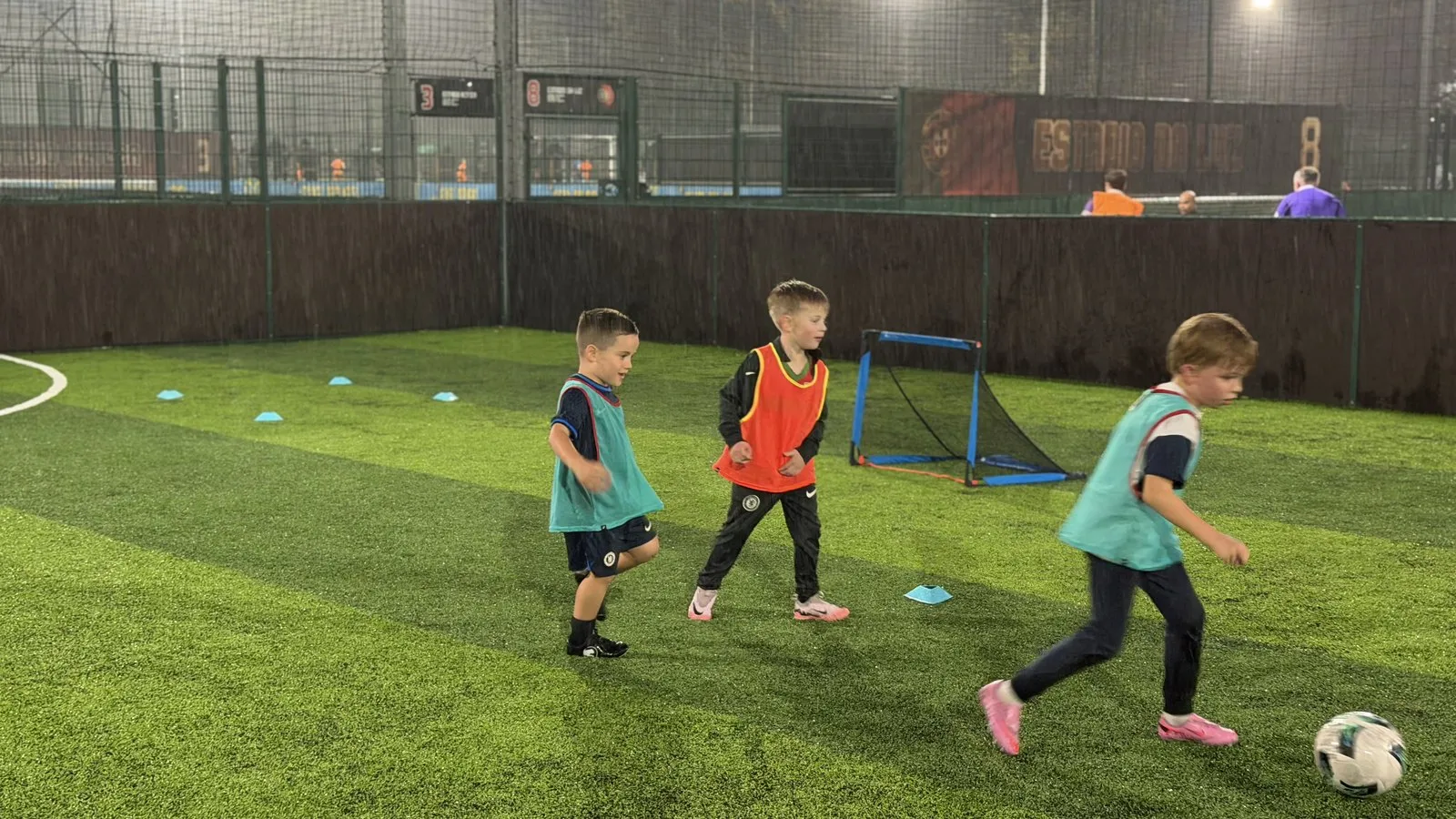
No laps and no queues. Every child has a ball from the first minute: dribbling in a square, stopping on a call, changing direction, little races. The body warms up and the feet are already working.
3. Skill practice, set up as a game
This is the coaching heart of the hour. The skill of the day is set up as a small game with a clear target: get through the gate, keep the ball from a defender, score in a mini goal. The coach shows the technique, children try it straight away, and the coach makes the game easier or harder for each child as it runs.
4. Small-sided match
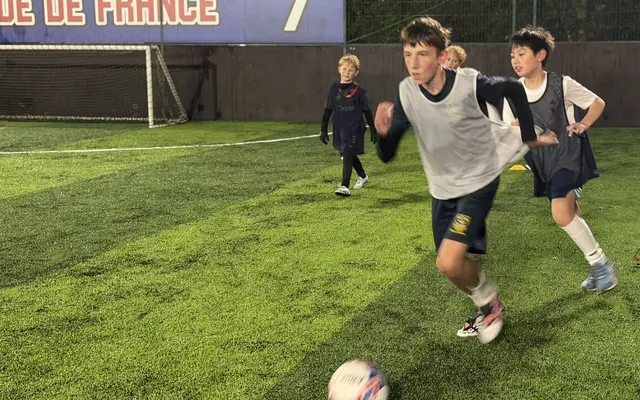
Short games with few players on each side, such as 3v3 or 4v4. Small teams mean every child touches the ball again and again and has to make real decisions. This is where the skill from the practice gets used under pressure. Our article on why 4v4 works explains what Manchester United found when its academy switched its under-9s to small games.
5. Finish
A minute together at the end. The coach picks out something each child did well and gives them one thing to try at home. Parents can ask questions on the way out.
How our coaching works
Two sessions can use the same game and get completely different results. The difference is the coach. These are the habits we hold ourselves to in every session.
- Touches first, talking second. Children learn football with the ball at their feet. We keep explanations short and get them playing.
- Show, then try. A quick demonstration gives a child something to copy. Long verbal instructions mostly get forgotten.
- Questions, not just answers. "Where was the space?" makes a child look up next time. Telling them where it was does not.
- Mistakes are part of the lesson. Losing the ball is how a player finds out what to try next. The coach gives a useful pointer and the child has another go.
- Every child is seen. Small groups mean the coach knows each child's name, what they are working on and how they are doing that week. Nobody spends the session at the back of a queue.
- Enjoyment is the engine. Children who enjoy training come back, and children who come back improve. Our sessions are serious about coaching and full of laughter.
Want to know what to look for in any session, not only ours? Our coaches wrote a guide to what good football sessions for kids look like.
What each age group works on
Minis, ages 4–7: first touches and the joy of the ball
Short games, lots of movement and simple targets. Stopping a rolling ball, dribbling with both feet, finding space and joining in with other children. Positions and match rules can wait. A good Minis session ends with a child who can't wait for next Tuesday. For ideas you can try at home, see our football practice guide for 4–7 year olds.
Juniors, ages 8–12: technique and game understanding
This is when skills come quickly. First touch, passing with both feet, turning, dribbling past a player, and the decisions that go with them: when to pass, when to run with it, where to stand. Most work happens in small-sided games, so technique and decisions grow together. Our article on football training for 8–12 year olds describes six of the games we use.
Teens, ages 13–17: playing at a higher tempo
At 13 the game changes: bigger pitches, 11-a-side, growth spurts and exams. Teens sessions add speed of play, positional understanding and physical preparation, while keeping the ball at the centre. Teenagers who play for a Saturday club can use our sessions as extra coaching. More in our guide to football training for teenagers.
Who coaches your child
Andrii Konevych founded Konevych FDC and leads sessions as head coach. Fredrik Frost is our second head coach. Both hold the UEFA C licence and bring experience from St Mary's University and a Chelsea FC Development Centre. You can read more on our coaches page.
Safety comes before any of the football:
- Every coach holds an Enhanced DBS check.
- We have a Designated Safeguarding Lead.
- There is a first aid kit at every session.
- Our club policy sets out how we keep children safe.
If you want to know what a coaching badge actually means, our guide to football coaching badges explains UEFA C, B and the rest in plain English.
Is Konevych FDC a football academy?
Parents often search for a "kids football academy in Tolworth", and the word means different things. A professional club academy, such as Chelsea's or Fulham's, picks players through scouting and trials. A coaching academy or development centre, like ours, is open to any child who wants to learn and focuses on training rather than league fixtures.
Konevych FDC is an independent kids' football academy in Tolworth for ages 4–17. Children of every level train with us: complete beginners, school-team regulars and club players who want more coaching in the week. Some go further. More than ten Konevych FDC players have earned places in Chelsea FC development programmes and still train with us, and we help players prepare for trials at Chelsea and other clubs. Konevych FDC is independent and not affiliated with or endorsed by Chelsea FC.
For the full picture, read what a football development centre is and academy vs club football.
What training costs
The first session is free and we do not take a card to book it. After that, you choose a plan in your parent account:
- Simple, one session a week: £64 a month (4 sessions), £180 for 3 months or £360 for 6 months.
- Medium, two sessions a week: £128 a month (8 sessions), £360 for 3 months or £720 for 6 months.
That works out at £15–16 a session. A single session costs £20. There is no joining fee and you can cancel a plan. See current training prices for the latest figures. For context, our article on what kids' football training costs in London compares typical prices across the city.
During school holidays we also run holiday football camps at Goals Tolworth, bookable by the day.
How to book a free first session
- Choose a slot. Pick your child's age group and a Tuesday or Thursday session on the free trial page. Booking takes about two minutes.
- Pack the basics. Football boots suitable for 3G or astro trainers, shin pads if you have them, a warm layer and a water bottle. Not sure about boots? Read our guide to football boots for 3G pitches.
- Arrive 5–10 minutes early. The coach will meet you and your child before the warm-up. Tell them if your child is nervous or new to football.
- Talk to the coach afterwards. They will tell you which group suits your child and answer any questions. There is no pressure to decide on the day.
Here is more on what to expect at your child's free trial, and a guide to parking and the entrance at Goals Tolworth.
Common questions
Does my child need to be good at football already?
No. Beginners join every group. The coach adjusts each game so a new player can take part and a confident one is still challenged. Our guide on which sessions suit beginners goes into detail.
How often should my child train?
Once a week is a good start, especially for Minis. Juniors and Teens who want more can move to twice a week once football becomes their main sport. Regular attendance matters more than the number of sessions.
Can my child train with you and play for a club?
Yes, and many do. A Saturday club gives them matches and a team; our weekly coaching gives them more touches and more individual feedback. The two work well together.
Do you coach girls?
Yes. Girls and boys are welcome in every age group, with the same coaching and the same chances.
What happens if it rains?
We train in the rain on floodlit 3G pitches, so dress your child for the weather. In severe weather a session may be cancelled.
Try a session in Tolworth
The best way to judge any coaching is to watch your child in a session. Pick a Tuesday or Thursday slot, bring boots and a water bottle, and see how the hour feels. Book your child's free football session. The first one is on us.
Want to put this into practice? We run weekly sessions for ages 4–17 at Goals Tolworth. Book a free trial.