Kids Football in Tolworth: A Parent's Guide
Clubs, academies and camps in Tolworth compared: what each age needs, the questions to ask, what it costs, and how a free first session at Goals Tolworth works.
Your child wants to play football. Maybe they came home from school talking about a friend's club, or they spend every spare minute kicking a ball against the fence. Either way, you are now searching "kids football Tolworth" and finding clubs, academies, camps and 5-a-side centres that all sound alike.This guide is for Tolworth parents and families nearby in Surbiton, Worcester Park, Berrylands, Hook and Kingston. It covers the types of football on offer, what changes at each age, what to ask before you sign up, what it costs, and how your child's first session works. We run a youth football academy at Goals Tolworth, so we say where we fit in. We also say where we don't.Short answer: most children can start football in Tolworth from age 4. Grassroots clubs give your child a team and weekend matches. Coaching academies like ours give smaller groups and more coaching in each session. Many families use both. Whichever you choose, check the coaches' qualifications and DBS checks, look for small age-grouped sessions with plenty of ball contact, and take a free trial before you pay for anything.
Why football is good for children
The UK Chief Medical Officers recommend that children and young people get an average of at least 60 minutes of moderate to vigorous physical activity a day. One football session gets a child running, turning, jumping and sprinting for most of an hour, and it does not feel like exercise to them because they are chasing a ball.The benefits go further than fitness:
- Coordination and balance. Dribbling, stopping and changing direction build the movement skills that carry over into every other sport.
- Friendships. Children who train together every week become a group. For a child who has just changed school, that matters.
- Confidence. Getting better at something you find hard, in front of other people, is how confidence is built. Football gives children that every week.
- Handling setbacks. Losing the ball, losing a game and trying again is good practice for life.
- Listening and discipline. Following an instruction, waiting for a turn and respecting a coach are habits that also show up in the classroom.
None of that depends on talent. A child who will never play professionally gets all of it.
Your options for kids football in Tolworth
"Kids football" covers several different things. Knowing which one you are looking at makes the choice much easier.
Grassroots clubs
A grassroots club enters teams into a local league, plays matches most weekends and trains once or twice a week. Coaches are usually volunteer parents with FA coaching badges. The biggest club on our doorstep is the Corinthian-Casuals youth section, based at King George's Field off Hook Rise South. It runs boys' and girls' teams from under-7s to under-17s under the Surrey FA.Clubs are the right place for match football, being part of a team, and the feeling of a club badge on the shirt. The trade-offs: popular age groups fill up and may have waiting lists, squads can be 10 to 14 players, and in the older groups not every child gets equal minutes on matchday.
Coaching academies and development centres
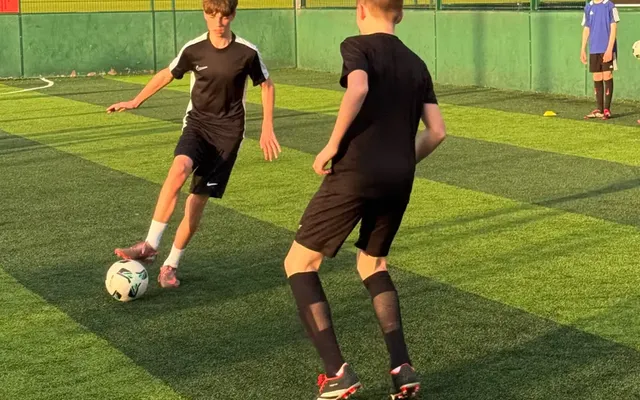
An academy or development centre focuses on training rather than league fixtures. Sessions are paid, groups are smaller, and the coaching is usually led by paid, qualified coaches. This is what we do at Konevych FDC. Children train in age groups at Goals Tolworth with UEFA-licensed coaches, and every session is built around getting the ball at their feet as often as possible.Academies suit children who want to improve faster, children who are not ready for competitive matches yet, and club players who want an extra session in the week. If you are weighing the two up, our guide to academy vs club football goes into more detail.
Holiday camps
Camps run during half-term and school holidays, usually for a full day. They are a low-commitment way to see whether your child enjoys football, and they help with childcare. We run holiday football camps at Goals Tolworth, bookable by the day.
School clubs and after-school sessions
Many primary schools in Tolworth and Surbiton run an after-school football club. These are convenient and cheap, but groups can be large and mixed in age. They work well as a first taste of football.What most families end up doing: one weekly training session with an academy for skills, plus a grassroots club for matches once the child is 7 or 8 and wants to compete. The two complement each other.
What kids football looks like at each age
A good programme does not coach a five-year-old like a mini adult. Here is what to expect, and what we focus on in each of our groups.
Ages 4 to 7: Minis
At this age football should be play with a ball. Sessions are full of games such as tag with a ball, "steal the treasure" and tiny matches, because young children learn by doing, not by listening to a coach. The aims are simple: lots of touches, using both feet, learning to stop and start, and enjoying it enough to come back next week.Signs your child is ready: they can follow a simple instruction, they are happy to be with a group without you right beside them for most of the session, and they like running about. If you are unsure, our article on what age kids can start football covers the signs in detail.
Ages 8 to 12: Juniors
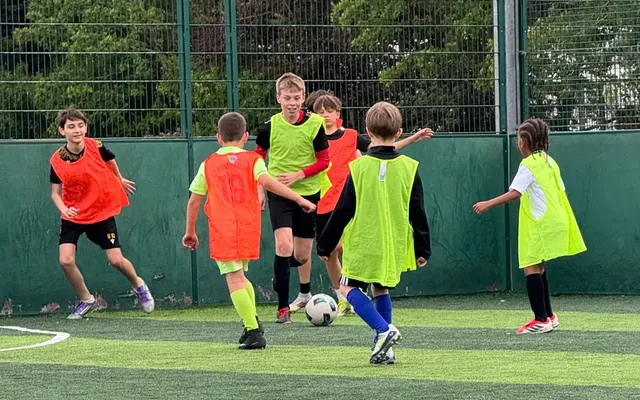
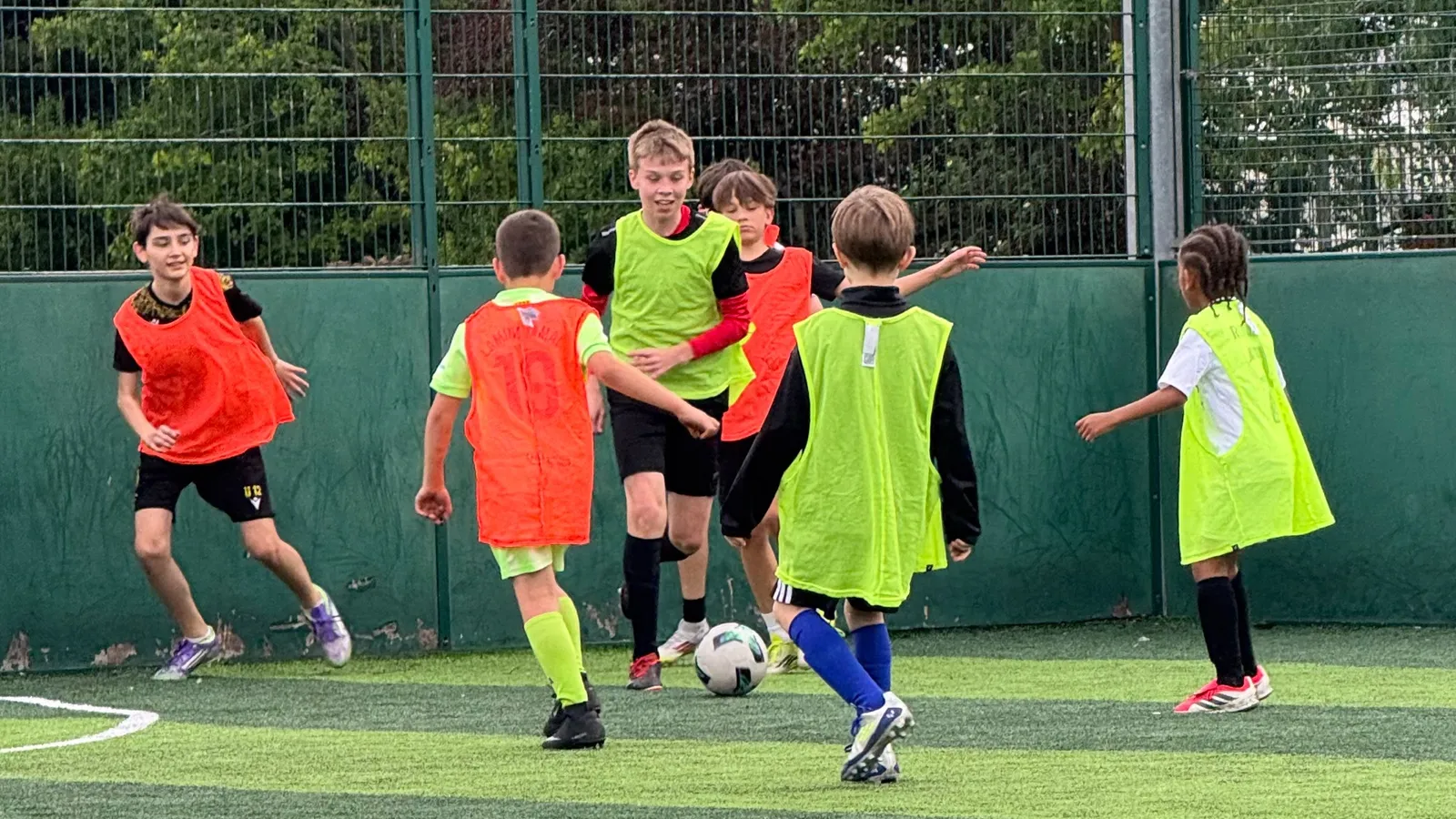
This is the best age for learning skills. Children can now pick up technique quickly: first touch, passing with the inside of the foot, dribbling past a player, turning away from pressure. They also start to understand space, positions and working with a teammate. Small-sided games carry most of the session, because they give each child far more touches than a full-size match. For practice ideas at this age, see football training for 8 to 12 year olds.
Ages 13 to 17: Teens
Teenagers move onto bigger pitches and into tactical work: shape, pressing, building play from the back, and the fitness to keep going for a full match. Bodies change fast at this age, so good coaches adapt the work for each player. Starting late is not a problem. Plenty of teenagers begin at 12 or 13 and catch up quickly. Read is my child too late to start football? if that is your situation.
The new FA match formats for 2026/27
From the 2026/27 season the FA has changed youth match formats in England as part of its FutureFit plan. The maximum format for each age group is now:
- Under-7s: 3v3, with no goalkeepers
- Under-8s and under-9s: 5v5
- Under-10s and under-11s: 7v7
- Under-12s and under-13s: 9v9
- Under-14s and older: 11v11
The reason is simple. Fewer players per side means more touches, more decisions and more goals for every child. It is the same idea behind the small-sided games in our sessions.
How to choose a football club or academy in Tolworth
Visit a session before you commit, and ask these questions. A good club answers them straight away and is not offended that you asked.
- Are the coaches qualified? Look for named qualifications such as FA or UEFA licences, not just "years of experience".
- Do all coaches hold an Enhanced DBS check? That means every coach and every assistant.
- Who is the safeguarding lead? There should be a named person and a written policy you can read before you sign up.
- How many children are in each group? Smaller groups mean more touches and more feedback for your child.
- Are children grouped by age? A six-year-old and a ten-year-old need different sessions.
- How much time is spent with the ball? Watch for queues. If children spend most of the hour waiting for a turn, they are not learning much.
- What happens if my child is hurt? Expect first aid on site and a way to reach you fast.
- Can my child try a session first? Any good club should let them.
We cover these in more depth, including the warning signs to look out for, in how to choose a safe football club for your child. Our own answers are in our club policy.
How much does kids football cost in Tolworth?
Prices vary widely, so compare the price per session and what that price includes.
- Grassroots clubs usually charge an annual registration fee plus monthly subs or match fees. Kit is often extra.
- Academies and development centres charge per session or by monthly plan. Groups are smaller and the coaches are paid.
- Holiday camps charge by the day.
- One-to-one coaching costs the most per hour, and suits a specific goal rather than a weekly habit.
At Konevych FDC the first session is free. After that, at the time of writing (October 2026), one session a week costs £64 a month, which is £16 a session, and drops to £15 a session on a six-month plan. Two sessions a week cost £128 a month. Holiday camps start from £70 a day. Our training prices are always up to date on the homepage.Watch for costs that are easy to miss: registration fees, compulsory kit bundles, tournament entry and travel to away matches. For a wider comparison across London, read what kids' football training costs in London.
Training at Goals Tolworth
All of our weekly sessions run at Goals Tolworth on Kingston Road, KT5 9NT. The centre has six floodlit 3G pitches, so sessions go ahead after dark in winter and rarely stop for rain. There is free parking on site, and it is two minutes from the A3 at Tolworth roundabout. That makes it an easy drive from Surbiton, Worcester Park, Berrylands, Hook, Chessington, New Malden and Kingston town centre.Current weekly sessions:
- Tuesday, 5:30pm to 6:30pm: Minis, ages 4 to 7
- Tuesday, 6:30pm to 7:30pm: Juniors, ages 8 to 12, and Teens, ages 13 to 17
- Thursday, 5:00pm to 6:30pm: Juniors, ages 8 to 12
Times can change between terms, so check the Goals Tolworth page for the latest slots before you book.
What your child needs to bring
- Boots for artificial grass. On 3G pitches, choose boots marked AG (artificial ground) or TF (turf), or moulded studs. Avoid metal studs. Clean trainers are fine for a first visit.
- Shin pads. Useful from the start. If you do not have any yet, tell the coach. Do not buy a pair just for a trial.
- A full water bottle with your child's name on it.
- Layers. Shorts and a T-shirt, plus a warm top for cold evenings. Autumn and winter sessions in Tolworth get chilly once the sun goes down.
- No jewellery. Remove earrings and watches before the session.
No club kit is needed to start.
How your child's first session works
- Book online. Choose an age group and a weekly slot on our free trial page. It takes about two minutes and you do not need a card.
- Arrive ten minutes early. Children who have time to look around start calmer than children who are rushed onto the pitch.
- Hand over to the coach. For younger children we ask parents to hand their child to the coach personally and stay nearby or reachable.
- Train. Your child joins a normal session with players their own age: a warm-up with a ball, skill practice set up as games, and small-sided matches.
- Talk to the coach. At the end, ask anything you like. If your child enjoyed it, you can choose a plan from your parent account. If not, there is nothing to cancel.
Nobody scores a trial player. Coaches watch whether your child joins in, listens and enjoys themselves. A quiet child who is smiling by the end has had a good first session. Read the full walk-through in what to expect at your child's free football trial.
How parents can help
- Praise effort, not goals. "You kept trying to win the ball back" teaches more than "You scored."
- Keep the touchline quiet. Let the coach coach. Shouted instructions from parents confuse children mid-game.
- Ask open questions on the way home. "What was the best bit?" works better than "Why didn't you pass?"
- Play at home. Ten minutes in the garden or at the park adds up. Our seven garden football games need one ball and a few markers.
- Protect sleep and food. A tired, hungry child has a bad session. A snack an hour before training helps.
For more, see our youth football training tips for parents.
Common questions
What age can my child start football in Tolworth?
From age 4. Our Minis group is for children aged 4 to 7, with short, game-based sessions. Most grassroots clubs start teams at under-7.
Does my child need any football experience?
No. Every group has beginners, and children train with players their own age. Coaches adjust the work so a first-timer and a regular can both get something from the same session.
Do you coach girls?
Yes. Girls and boys are welcome in every age group, and we give every child the same opportunities whatever their gender or ability.
Can my child play for a club and train with you as well?
Yes, and many do. A weekly academy session alongside club matches gives children more touches and more coaching than either one alone.
Is there parking at Goals Tolworth?
Yes. There is free parking on site at Goals Tolworth, KT5 9NT, just off the A3 at Tolworth roundabout.
What if my child is nervous?
Tell the coach before the session starts. They can keep your child close, pair them with a friendly player and keep the first activity easy. You are welcome to watch from the side for the first session.
Book a free session in Tolworth
The quickest way to find out whether a football programme suits your child is to try it. Your child's first session at Konevych FDC is free, with UEFA-licensed coaches, players their own age and a pitch two minutes off the A3.Book your child's free football session in Tolworth, or see the full programme and coaches on our homepage.
Want to put this into practice? We run weekly sessions for ages 4–17 at Goals Tolworth. Book a free trial.