How to Get Into a Football Academy in South West London
How kids really get into a professional football academy near Tolworth: how scouting works, which academies are within reach, the trial and registration rules, and what parents can do to help.

Short answer: children get into a professional football academy by being spotted, not by applying. A club scout sees them play for a grassroots team, at a club-run development centre or at a school or district event. The club then invites them for a trial of up to eight weeks, and offers registration if they want to keep them. Academy registration starts at under-9, the season a child is 8 on 31 August. Around Tolworth, families are within reach of several Category One academies, including Chelsea, Fulham, Brentford and Crystal Palace. Most academy players are released before they turn professional, so the best thing a parent can do is keep football fun, keep their child playing every week, and let good coaching do the rest.
We run Konevych FDC, an independent football development centre at Goals Tolworth. We are not a club academy and we don't promise academy places. This guide explains how the system works, using the Premier League's own rules and parent handbook, so you know what to expect if a scout ever gets in touch.
How does the academy system work?
Professional club academies in England run under the Premier League's Elite Player Performance Plan (EPPP). It splits the pathway into three phases:
- Foundation Phase: under-9 to under-11.
- Youth Development Phase: under-12 to under-16.
- Professional Development Phase: under-17 to under-21.
Every academy is audited each year and placed in a category from one to four:
- Category One is the highest level. Players get the most coaching, and full-time education can be offered from under-12. Category One academies can also recruit nationally from under-14.
- Category Two academies usually recruit locally but still offer extra coaching and educational support.
- Category Three academies give players professional coaching and development opportunities.
- Category Four academies only work with players aged 17 to 21.
In the Foundation Phase, children train part-time: evenings, weekends and school holidays. The Premier League's guide for Foundation Phase parents says to expect at least four coaching hours a week. At a Category One academy, that rises to eight hours a week for older players.
Which academies are near Tolworth?
South West London and Surrey have an unusual number of top-level academies within reach. Categories are reviewed every year, so treat this as a snapshot from October 2026:
| Club | Academy category | Notes |
|---|---|---|
| Chelsea | Category One | Trains at Cobham, Surrey |
| Fulham | Category One | Trains at Motspur Park. Category One since the EPPP began in 2012 |
| Brentford | Category One from 2026/27 | Reopened its academy four years earlier |
| Crystal Palace | Category One | Promoted in July 2020. Trains in Beckenham |
| AFC Wimbledon | Category Three | Covers under-9 to under-21 |
Distance matters more than most parents expect. The Youth Development Rules only allow a club to register a Foundation Phase player (under-9 to under-11) who lives within one hour's travel of the academy. From under-12 to under-16 the limit is 90 minutes, and Category One academies can go beyond that for under-14s to under-16s on a full-time training programme. In practice, the academies that can sign your child are the ones within that travel time of home.
How do children actually get spotted?
Academies don't take applications. Scouts look for players, and they look where children play regularly:
- Grassroots matches. Scouts watch weekend league football. A child who plays every week for a local club is easy to see.
- Club-run development centres. Professional clubs can run pre-academy and junior training centres for children with the potential to become academy players. These are a club's way of watching younger children before under-9 registration. Read what a football development centre is for the difference between club-run and independent centres.
- School and district football. Representative teams and tournaments give scouts a look at the best players from many schools at once.
Every scout must be registered with the club they work for. If someone approaches your child, ask which club they represent, then check with that club directly before you agree to anything.
What happens at an academy trial?
If a club is interested, it invites your child to train with the academy as a "trialist". The Youth Development Rules set clear limits:
- A trial can last up to eight consecutive weeks in a season. For under-9s to under-16s, the club can ask the Premier League for four more weeks, but only with your consent.
- The club must give seven days' written notice to your child's grassroots club and school before the trial starts.
- During the first seven weeks of the trial, your child can't register with another academy.
For how to prepare, what coaches watch for and what to do if your child isn't taken on, see our guide to football trials for kids.
What happens if your child is offered a place?
You complete a registration form with proof of address and date of birth, and the Premier League processes it. If you change your mind, you have seven days to contact the Premier League and cancel. Some rules every parent should know:
- The earliest date for under-9 registration. No under-9 registration can be signed before the third Saturday in May before your child's under-9 season. Anything you sign before then does not bind your child to the club.
- Grassroots football. In the Foundation Phase, academy players can sometimes keep playing for their grassroots team if the academy agrees. From under-12 they can't.
- No contact with other clubs. While your child is registered, you can't approach other Premier League or EFL clubs, and their staff, scouts or agents can't approach you.
- No inducements. Clubs are not allowed to offer cash or other benefits, such as travel or accommodation costs, to persuade your child to sign.
- Compensation is between clubs. If your child turns down a new registration and joins another academy, the new club may owe the old club compensation. Parents don't pay it and don't receive it.
- Contracts come late. A club can't offer a professional contract until your child's under-16 year, and they can't sign one until they're 17.
- Each registration period ends with a decision. The club confirms in writing whether it will renew your child's registration. If you want to decline a new registration, you must tell the club and the Premier League in writing by the first Saturday in June.
The Professional Footballers' Association runs a free, independent Youth Advisory Service for academy players, trialists and parents. Use it if you are unsure about an offer.
What are the real chances?
We'd rather you hear this from us than find out later. A 2022 article by a Nottingham Trent University researcher brought together the figures. Half of all academy players leave the system before they are 16. Premier League data reported by the i newspaper found that 97% of former Category One academy players never played in the Premier League.
The Premier League's own parent handbook is honest about this too. It asks clubs to make sure young players don't feel defined by football and keep interests outside it. Being released is common, and it doesn't have to be the end of football. A released player can go straight back to grassroots football.
What can parents do to help?
- Keep them playing every week. Scouts can only spot children who play regularly, in matches and in training.
- Prioritise enjoyment. Children who love the game practise without being asked, and that is how they improve.
- Find good coaching. Small groups, plenty of time on the ball and coaches who teach decision-making all build the skills scouts look for. Our article on signs of real football potential explains what coaches mean by that.
- Don't pay to be "seen by scouts". Academies recruit through their own registered scouts. Be wary of anyone who charges for a guaranteed scout, trial or route into a club.
- Stay calm on the sideline. A relaxed child plays better.
Where Konevych FDC fits
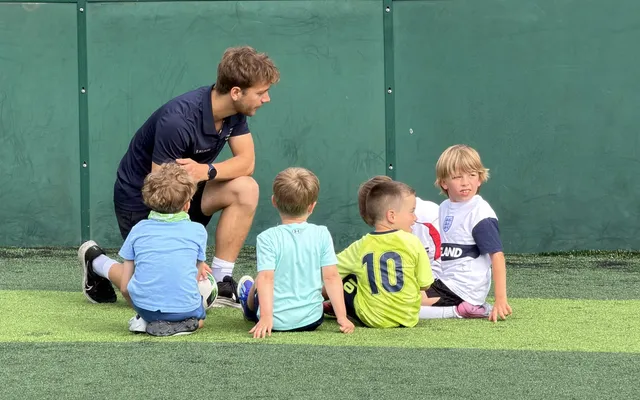
We are an independent development centre, not part of a professional club's academy. We coach children aged 4 to 17 at Goals Tolworth in small age groups, with UEFA-licensed coaches, and we build the technical skills and confidence that matter whatever level your child reaches. We will tell you honestly how your child is progressing, and we won't promise anyone a trial.
If you are deciding between an academy, a grassroots club and coaching like ours, our academy vs club football guide compares them. Our parent's guide to kids' football in Tolworth covers every local option. Your child's first session with us is free: book a free trial.
Common questions
What age can my child join a football academy?
Academy registration starts at under-9, the season your child is 8 on 31 August, which is usually school Year 4. Before that, clubs can watch younger children through their own pre-academy development centres.
Do you have to pay to get into a football academy?
Academy places come by invitation from the club after scouting and a trial, not by buying a place. Club-run development centres and independent coaching centres, ours included, are different: they usually charge a fee. If anyone asks you to pay for a guaranteed academy trial, check with the club first.
Can my child apply to Chelsea or Fulham academy?
Not directly. Academies recruit through scouting, so the realistic route is to play regularly for a grassroots team or a club development centre, where scouts can see your child.
What happens if my child is released?
They can join another academy, if one wants them and they live within the travel limits, or go back to grassroots football straight away. Release is common at every age. Keep the focus on enjoyment, and talk to the PFA Youth Advisory Service if you'd like independent advice.
Sources
All checked October 2026:
- Premier League: Parent/Carer Handbook, Foundation Phase 2026/27
- Premier League: Youth Development Rules 2025/26 (Rules 135, 261–266, 290)
- Brentford FC: Category One academy status
- Training Ground Guru: Fulham retain Category One status and Crystal Palace awarded Category One status
- AFC Wimbledon Development Squad and Academy
- The Conversation: being released from a football academy (2022)
Want to put this into practice? We run weekly sessions for ages 4–17 at Goals Tolworth. Book a free trial.