Football Age Groups 2026–27: Which Group Is My Child In?
Your child's football age group depends on their age on 31 August. Find their 2026/27 group by birth date, plus match formats, playing up and mixed teams.

Short answer: in England, your child's football age group is set by their age on 31 August, the day before the season starts. A child who is 6 on 31 August plays Under 7s, a child who is 7 plays Under 8s, and so on. Find your child's birthday in the table below to see their group for the 2026/27 season.
Which age group is my child in for 2026/27?
Every age group runs from 1 September to 31 August, the same way school years do in England. A child starting Year 3 at school in September 2026 is in the Under 8s.
Born betweenAge group 2026/27Match format
1 Sep 2019 – 31 Aug 2020 | Under 7 | 3v3
1 Sep 2018 – 31 Aug 2019 | Under 8 | 5v5
1 Sep 2017 – 31 Aug 2018 | Under 9 | 5v5
1 Sep 2016 – 31 Aug 2017 | Under 10 | 7v7
1 Sep 2015 – 31 Aug 2016 | Under 11 | 7v7
1 Sep 2014 – 31 Aug 2015 | Under 12 | 9v9
1 Sep 2013 – 31 Aug 2014 | Under 13 | 9v9
1 Sep 2012 – 31 Aug 2013 | Under 14 | 11v11
1 Sep 2011 – 31 Aug 2012 | Under 15 | 11v11
1 Sep 2010 – 31 Aug 2011 | Under 16 | 11v11
1 Sep 2009 – 31 Aug 2010 | Under 17 | 11v11
1 Sep 2008 – 31 Aug 2009 | Under 18 | 11v11
Next season, every child moves up one group. A child in Under 8s for 2026/27 will be in Under 9s for 2027/28, whatever month their birthday falls in.
Why is my child "Under 8" when they're only 7?
Because the name describes the oldest age in the group, not your child's age. Under 8s are children who are 7 on 31 August. Most of them turn 8 during the season, but nobody in the group is 8 when it starts. That's why a child born in late August and one born the previous September can be almost a year apart and still play in the same group.
Does it matter if my child is summer-born?
It can, especially in the early years. A child born on 31 August and a child born on 1 September the year before are in the same group, but one has had almost a whole extra year to grow, build coordination and get used to being part of a team. At 7, that can mean a big difference in height, speed and confidence.
Studies of English academies have repeatedly found more players born in the autumn, at the start of the selection year, than in the summer. Coaches call this the relative age effect. Older children in a group tend to look more able, get picked more often and get more attention from coaches, which widens the gap over time.
What this means for you:
- If your child is one of the youngest in their group and finds it hard, their birthday may be the reason, not their ability. Give it time before deciding football isn't for them.
- Look for coaches who judge children on skill, effort and decisions, not on size and speed.
- Small-sided games help younger children most, because everyone gets the ball, not just the biggest player on the pitch.
What is the youngest age for matches?
The FA's rules say a child who has not turned 6 must not play in a match of any kind. Under 7s is the first age group. A child who turns 6 during the season can join an Under 7 team once they are 6, but not before.
Training is different. Many clubs, including ours, run coaching sessions from age 4. These are small games and skills, not competitive matches. If your child is 4 or 5, our guide on what age kids can start football explains what football looks like before matches begin.
What does each age group play from 2026/27?
England Football's FutureFit changes start this season. Every match format now comes a year later than before, so children spend longer in small games and get more touches of the ball.
Age groupFormatBallMatch length
Under 7 | Up to 3v3, no goalkeepers | Size 3 | Short games of 6–10 minutes
Under 8 and 9 | Up to 5v5 | Size 3 | 40 minutes
Under 10 and 11 | Up to 7v7 | Size 3 | 50 minutes
Under 12 and 13 | Up to 9v9 | Size 4 | 60 minutes
Under 14 and up | 11v11 | Size 5 | 70–90 minutes
In Under 7s every child plays and there are no substitutes. From Under 8s, the FA recommends that every child plays at least half of each match.
Why might my child's team still play the old format?
Teams that already existed move across over two seasons rather than overnight. The FA's own example: a team that played 5v5 as Under 7s in 2025/26 keeps playing 5v5 in 2026/27 and 2027/28, then moves to 7v7 in 2028/29. So if your child's team played a bigger format last season, it may stay there for now. Ask the coach which format they are using.
Can my child play up an age group?
Yes, one group. The FA's rules let a child play in the age group directly above their own, so an Under 9 can play for an Under 10 team. They can't jump two groups. There is one exception: a child who turns 6 after 31 August can only play Under 7s that season.
Playing up suits some children: those who are physically strong, confident, and bored at their own level. It can also knock a child's confidence if every game feels like a struggle. A good test is whether your child still gets plenty of the ball. Our article on why children lose confidence in football covers the warning signs.
Can my child play down an age group?
Not in mixed football. The rules let a child play in their own age group or the one directly above, never below. The one exception is all-girls teams, which can ask to play one age group down in a mixed competition. If your child is small for their age or new to the game, the answer is a team at their own age that plays to their level, not a younger group.
Can boys and girls play in the same team?
Yes. In England, girls can play in mixed teams right through youth football, as well as in girls-only teams.
Are scores and league tables kept for young children?
Not in public. Under the FA's rules, leagues and clubs can record results for Under 7s to Under 11s but must not publish them or any league tables. The aim is for young children to play to learn, not to protect a position in a table. From Under 12s, results and tables can be published.
When does the football season start?
The season starts on 1 September, the same date the age groups change. Most grassroots leagues play their matches between September and the spring, and many clubs hold trials or open sessions over the summer for the season ahead.
Questions to ask before your child joins a team
Once you know your child's age group, a few questions will tell you whether a team is the right fit:
- Which format will they play? Check whether the team has moved to the new FutureFit formats or is finishing its cycle on the old one.
- How is playing time shared? The FA recommends that every child plays at least half of each match from Under 8s. Ask whether the team follows that, and what happens when a child misses training.
- When do they train and play? Ask about the training night, the match day and how far away games are, so you know what the week will look like.
- Are the coaches qualified and checked? Ask about FA or UEFA coaching qualifications, an enhanced DBS check and first aid. Our guide to choosing a safe football club has the full checklist.
- What kit is needed? Shin pads are compulsory in matches under the Laws of the Game. On artificial pitches, moulded studs or astro trainers are usually required, and metal studs are often banned.
How do our training groups compare?
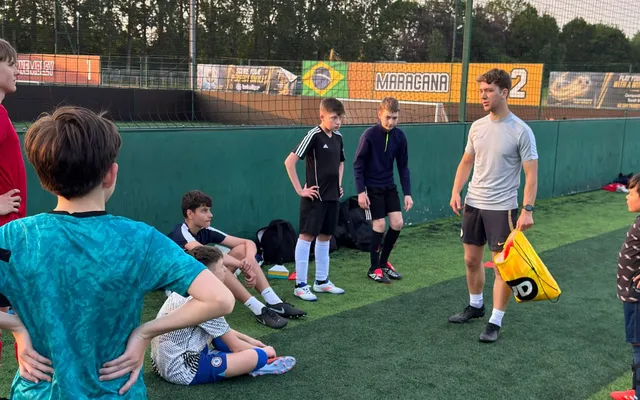
We are a football development centre, so our sessions are coaching, not league fixtures. We group children by their age on the day, in three bands:
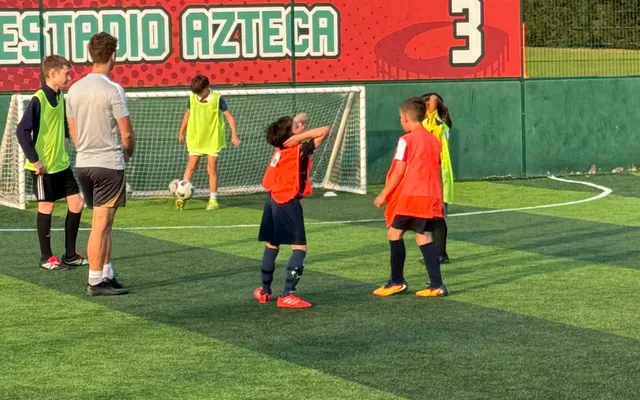
- Minis, ages 4–7: first skills and small games, starting before the FA's minimum age for matches.
- Juniors, ages 8–12: passing, positions and small-sided games, the same years the FA formats grow from 5v5 to 9v9.
- Teens, ages 13–17: 11-a-side ideas, tactics and fitness, for experienced players and teenagers starting late.
All three groups train at Goals Tolworth. Your child's first session is free: book a free trial and we'll place them in the right group from their date of birth.
Related reading
Sources
All checked October 2026:
- England Football: FutureFit, youth match formats from 2026/27
- Lovell et al. (2015): relative age and player selection in English development programmes, PLoS ONE
Further reading: whether it is too late to start football and school holiday football camps.
Want to put this into practice? We run weekly sessions for ages 4–17 at Goals Tolworth. Book a free trial.