What age can kids start football? UK parent's guide
When is the right time to start? Readiness signs, what football looks like from 3 to 13+, how matches work in England from 2026/27, and how to choose a first club.

Short answer: Most children can start football at around 4, in short, playful group sessions built around one ball each. From 2 to 3, kicking a ball at home or in the park is all they need. Organised matches in England begin at Under 7s, with 3v3 games from the 2026/27 season. Readiness matters more than a birthday.
What age can kids start football?
Children can start football as soon as they can run and kick a ball, usually around 2. Group sessions with a coach work best from about 4, when most children can follow a simple instruction, take turns and stay with a group for 45 minutes or so. Competitive matches in England start at Under 7s.
There is no single right age. A confident 4-year-old who loves chasing a ball is ready. A shy 5-year-old who needs to stand next to a parent for the first few weeks can be ready too. What counts is whether football feels like play.
| Age | What football looks like | Where it happens |
|---|---|---|
| 2–3 | Kicking, chasing, stopping a rolling ball, running about | Home, garden, park, toddler classes |
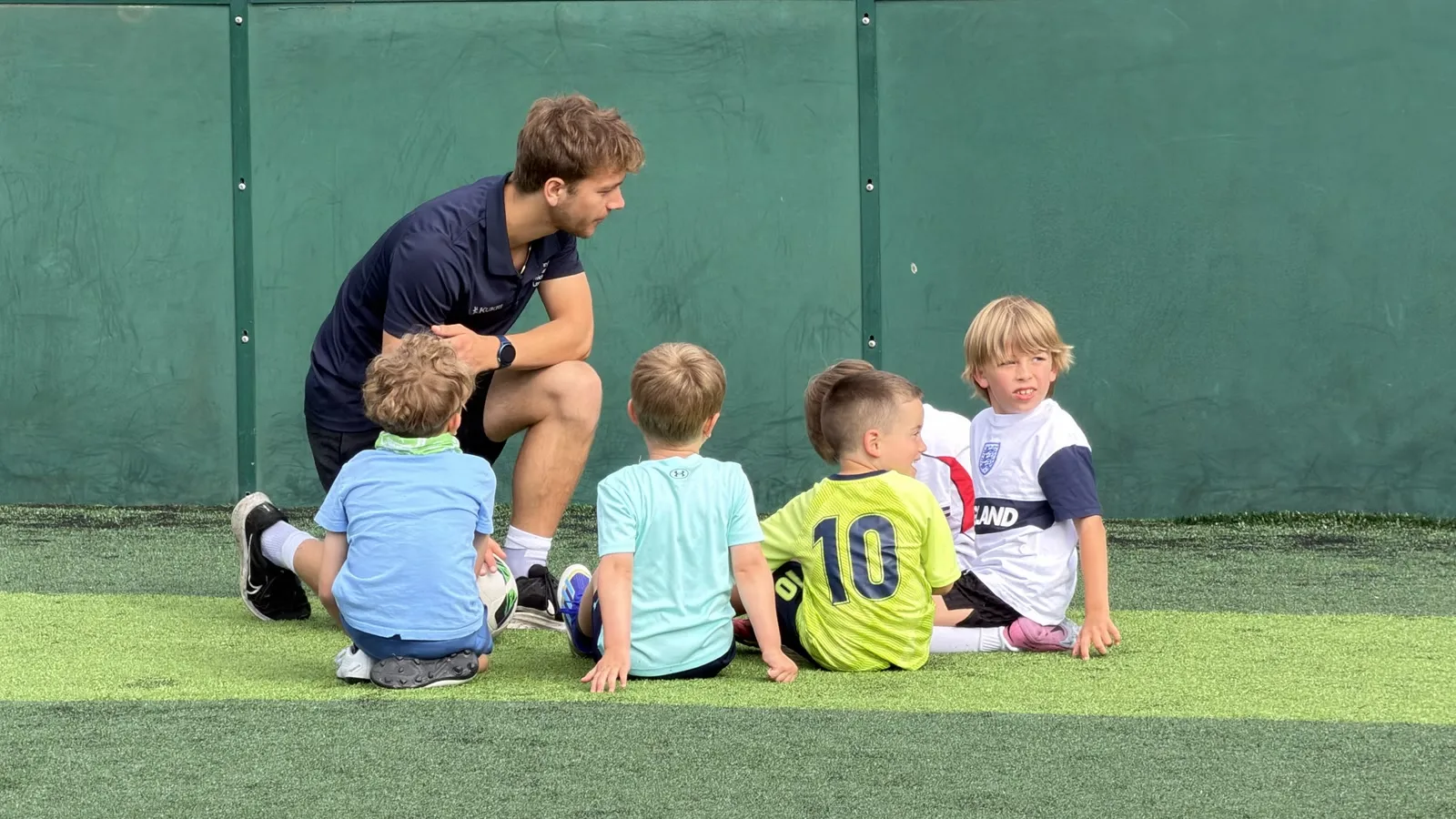
| 4–5 | Short games, one ball each, lots of touches, simple rules | Small-group sessions with a coach |
| 6–7 | Dribbling, passing, first small matches (3v3 at U7) | Sessions plus first matches |
| 8–12 | Passing, positions, small-sided matches (5v5 to 9v9) | Weekly training and matches |
| 13+ | Full-size matches from U14, tactics, fitness | Training, 11v11 matches |
Is my child ready for football? Seven signs
Your child is probably ready for a group session if most of these sound familiar:
- They ask to play with a ball, or pick one up without being asked.
- They can run, stop and change direction without falling over every few steps.
- They can follow a one-step instruction, such as "dribble to the cone".
- They can manage 30–45 minutes of activity with a drink break.
- They can wait for a short turn, even if it's not easy yet.
- They're happy to be near other children, even if they don't join in straight away.
- They can tell you when they need the toilet. That one matters more than any skill.
If two or three are missing, wait a few months and keep playing at home. Our article on football practice for 4–7 year olds has five ten-minute games to play together in the meantime.
What does football look like at each age?
Ages 2–3: play first
At this age, football is a ball and some space. Rolling it, chasing it, kicking it at a wall and laughing when it goes the wrong way. Toddler classes can be fun, but they aren't necessary. The UK Chief Medical Officers recommend at least 180 minutes of activity a day for under-5s, and a ball in the garden counts.
Ages 4–5: first sessions
This is when most children join their first group. A good session for 4- and 5-year-olds:
- Gives every child their own ball for most of the session.
- Uses games with stories (traffic lights, pirates, "steal the treasure") instead of lines and lectures.
- Keeps every activity short and changes it before attention drops.
- Ends with a small game and a high five.
Expect plenty of chaos. A child who spends half the session running the wrong way with a big smile is doing exactly what they should.
Ages 6–7: the first matches
Children learn to dribble with their head up, pass to a friend and shoot. From the 2026/27 season, Under 7s play 3v3: three players a side, no goalkeepers, no offside and no heading, so every child is close to the ball. Some clubs also start matches against other teams at this age.
Ages 8–12: the game starts to make sense
This is the age when children start to see space, understand positions and enjoy matches with a bit more at stake. Formats grow from 5v5 to 9v9. Our football training for 8–12 year olds guide has six games coaches use at this age.
Starting at 13 or older
Teenagers who start late can still enjoy football and improve quickly, because they understand instructions and tactics. Most clubs place them by ability. We cover this below.
How does children's football work in England in 2026/27?
From the 2026/27 season, England Football's FutureFit changes mean every format is played one year later than before. Children spend longer in small games, where they get more touches.
| Age group | Match format | Ball size |
|---|---|---|
| Under 7 | 3v3 | 3 |
| Under 8–9 | 5v5 | 3 |
| Under 10–11 | 7v7 | 3 |
| Under 12–13 | 9v9 | 4 |
| Under 14+ | 11v11 | 5 |
Deliberate heading is not allowed in affiliated matches from Under 7s to Under 11s. Heading is introduced gradually from Under 12s, following The FA's guidance.
How long and how often should young children train?
For 4- to 7-year-olds, one session a week is a good start. Add a second if your child keeps asking for more. Many clubs run 45–60 minutes at this age, broken into short games with drink breaks.
The UK Chief Medical Officers' guidelines say children aged 5 to 18 should average 60 minutes of moderate-to-vigorous activity a day across the week. Football can be part of that, alongside scooting, swimming, climbing and playground games. Playing different sports at a young age helps children build balance and coordination, which they bring back to football.
Is it too late to start football at 9, 11 or 13?
No. A child who starts at 9 or 10 has missed some touches, but not the chance to enjoy the game and become a good player. Late starters often learn fast because they already understand rules, teamwork and practice.
What helps late starters:
- A group by ability or age band, so they're not dropped into a team of players who've trained together for five years.
- Small-sided games, which give them far more touches than 11v11.
- A coach who notices progress and tells them about it.
How do I choose a first football club for my child?
Look for a club where your child will spend the session playing, not queuing. Questions to ask:
- Are the coaches qualified? Ask about FA or UEFA licences and first aid.
- Do coaches have an enhanced DBS check? This is the basic safeguarding check for anyone working with children.
- How big are the groups? Smaller groups mean more touches and more attention for each child.
- Are children grouped by age? A 4-year-old and a 7-year-old need different sessions.
- Does every child get a ball? At 4 to 7, they should.
- Is there a free trial? A first session lets your child decide whether they like it.
- Will the coach know your child's name by the end of the first session? It's a small thing that tells you a lot.
What should my child bring to their first session?
- Comfortable sports clothes for the weather, and layers in autumn and winter.
- Trainers or football boots. On 3G pitches, look for AG (artificial grass) or astro soles. Trainers are fine for the first few weeks.
- Shin pads, if you have them.
- A named water bottle.
- Arrive ten minutes early, so your child can see the pitch before it fills up.
It's normal for a young child to watch for the first few minutes. Let the coach invite them in. Most join within ten minutes once they see the others laughing.
Questions parents ask
Can a 3-year-old play football?
Yes, at home and in the park, and in toddler classes built around play. Group coaching works better from about 4, once a child can follow simple instructions and stay with a group.
Is 4 too young for football training?
No, if the session is designed for 4-year-olds: short games, one ball each, lots of encouragement. It's too young for long instructions, standing in lines or full-size matches.
Is 10 too late to start football?
No. Children who start at 10 can enjoy the game, improve quickly and play in a team. Look for a club that groups by ability and plays small-sided games.
Does my child need football boots?
Not for the first sessions. Trainers are fine. On a 3G or astro pitch, AG or astro boots give better grip once your child plays regularly.
How often should a 5-year-old play football?
One coached session a week, plus free play at home or in the park, is plenty. Children aged 5 to 18 should average 60 minutes of activity a day across all sports and play.
When do kids start playing matches in England?
Affiliated matches start at Under 7s. From the 2026/27 season, Under 7s play 3v3, with no goalkeepers and no heading.
Starting football at Konevych FDC in Tolworth
Konevych FDC coaches children from age 4 at Goals Tolworth, near Surbiton and Kingston. Our Minis (4–7) sessions are small groups with a ball for every child, games instead of queues, and UEFA-licensed coaching. Juniors (8–12) and Teens (13–17) follow their own age-based curriculum, so late starters join a group that fits them.
Every child's first session is free. Book a free trial and let your child decide.
Sources
- England Football, FutureFit: changes to youth football from 2026/27, and Pitch and goal sizes for the different age groups: futurefit.englandfootball.com
- The FA, New rule to phase out heading in grassroots youth football matches (May 2024): thefa.com
- UK Chief Medical Officers, Physical Activity Guidelines (2019): gov.uk
Want to put this into practice? We run weekly sessions for ages 4–17 at Goals Tolworth. Book a free trial.