Winter Football Training for Kids: A Parent's Guide
The clocks go back, the evenings turn dark and the rain sets in. Here is why winter matters for your child's football, what changes in our sessions, and how to keep them warm and keen until spring.

The clocks go back on the last Sunday of October. By the first week of November it is dark before most children are home from school, the pitch is wet and the car thermometer says six degrees. On a Tuesday evening, with a tired child on the sofa, it is tempting to say "let's stop until spring".
Before you decide, here is why winter is worth it, what changes in our sessions once the weather turns, what your child should wear, and how to keep them warm, healthy and keen until the light comes back.
Why keep training through winter?
A school year has roughly five months of cold, dark evenings. If a child stops in November and starts again in March, they lose almost half a year of football. Skills like first touch, dribbling with both feet and scanning before the ball arrives come from thousands of repetitions. Lose four months of repetitions and the spring starts with catching up.
There is a second reason, and parents notice it more than the first. Children who train together every week become a group. They know each other's names, they pass to each other, and they look forward to seeing friends on Tuesday. A long winter gap breaks that habit, and the first session back can feel like starting at a new club. For a shy child, that first session is often the hardest part of football.
Winter also teaches something the summer can't. Turning up on a cold, wet evening and working hard for an hour builds a kind of resilience children are proud of. That carries over into school, into matches and into the next hard thing they try.
None of this means a child has to train every week regardless. If your child is ill, exhausted or simply needs a night off, take it. One missed session changes nothing. What we suggest avoiding is a four-month gap.
What changes in our winter sessions
The session plan stays the same in winter: lots of touches on the ball, games with small numbers per team, and coaching matched to each age group. A few things change once the temperature drops.
- Longer, more active warm-ups. Cold muscles need more time. The warm-up runs longer and starts with the ball moving straight away, so children are never standing still while they get going.
- Less standing, more playing. Long explanations happen in the warm months. In winter the coaching points are short and given while children are moving. If a child is standing in a queue, the drill is wrong.
- Short drink breaks. Quick drinks and straight back in. Long breaks in the cold are when children start to shiver.
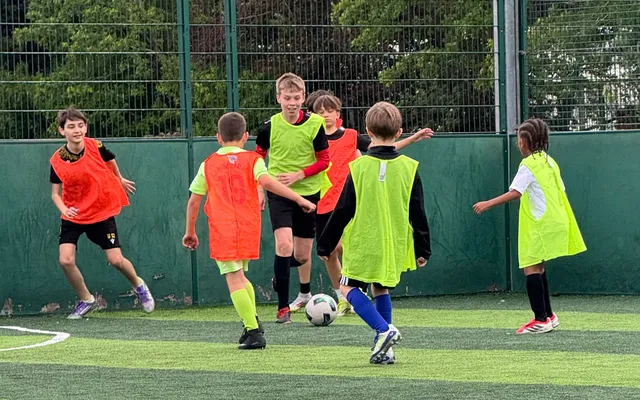
- Games that keep everyone involved. Small-sided games such as 3v3 and 4v4 mean every child touches the ball often and keeps moving. That is good coaching all year, and in January it also keeps them warm.
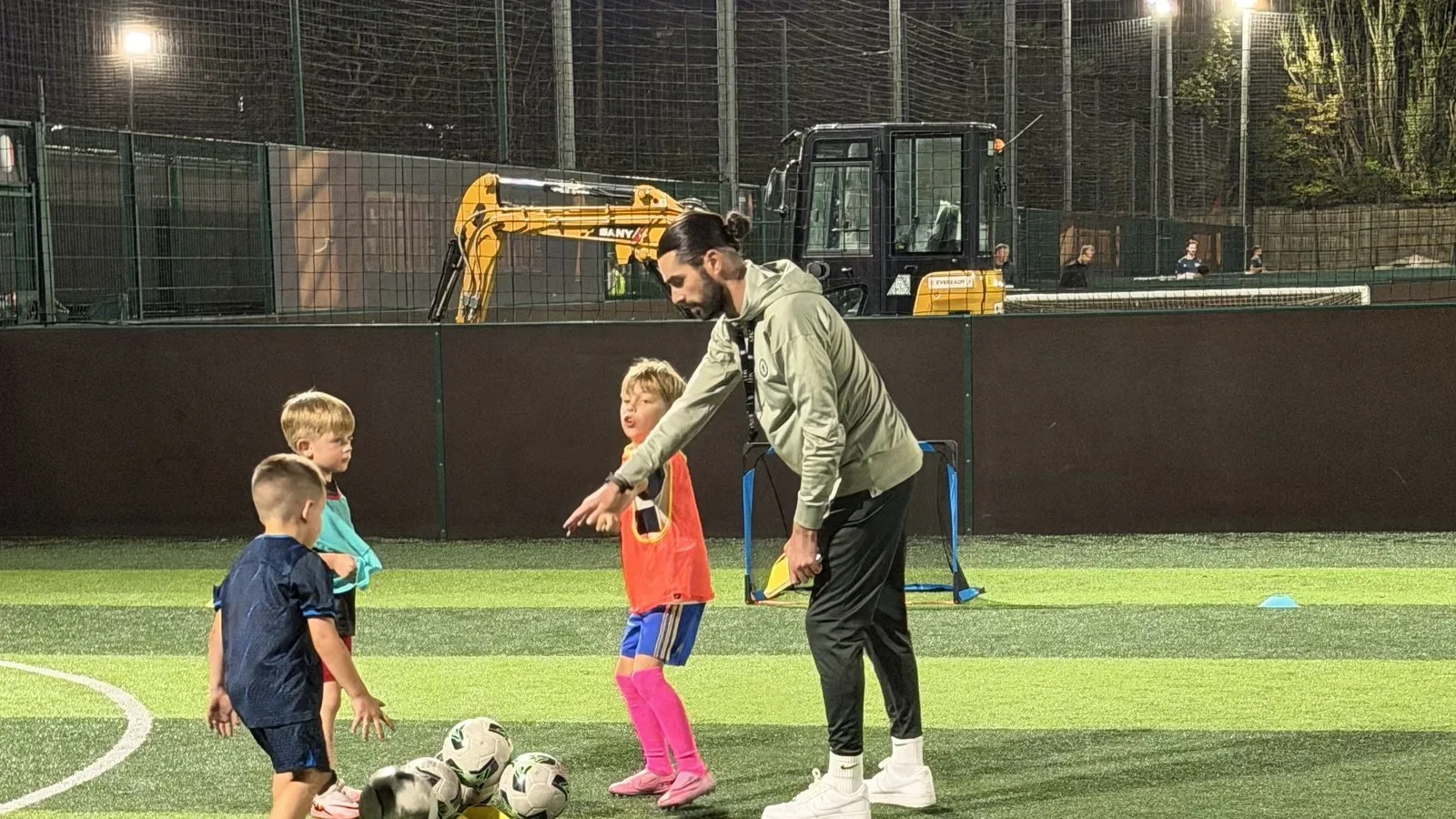
For the youngest players, ages 4 to 7, the coaches watch closely for cold hands and quiet faces. A five-year-old won't always tell you they are cold, but they will stop running. When that happens, the game changes to something faster.
Floodlit 3G vs grass in winter
Most winter cancellations in grassroots football come from the pitch, not the players. Grass pitches get waterlogged, councils close them to protect the surface, and matches and training are sometimes called off for weeks. Unlit pitches can't be used at all after about half past four in December.
All of our weekly sessions run at Goals Tolworth on Kingston Road, KT5 9NT. The centre has six floodlit 3G pitches. Artificial grass drains quickly and the floodlights mean sessions go ahead after dark, so training rarely stops for rain. That consistency matters: children improve with regular practice, and a pitch that is closed three weeks in a row doesn't give them that.
3G also changes the kit. Boots with metal studs or long screw-ins are made for soft grass and grip badly on artificial pitches. On 3G, choose boots marked AG (artificial ground) or TF (turf), or moulded studs.
What to wear for winter football
Children lose heat fast, and they lose it fastest before the session starts and after it ends. Dress for both.
- A thermal base layer. A thin long-sleeved top and leggings under the kit make the biggest difference, and they don't get in the way of playing.
- Football top and a warm training top. Your child can take the outer layer off once they warm up and put it back on afterwards.
- Gloves. Thin running or football gloves keep hands working. Children hate cold fingers more than anything else.
- A hat or snood. Useful for warm-ups and the walk back to the car. Ask the coach before your child plays in a snood.
- A waterproof layer when rain is forecast.
- 3G boots and shin pads. As above: AG, TF or moulded studs.
- A water bottle. Children still sweat in the cold and are less likely to drink because they don't feel thirsty.
Keep a bag in the car with a dry top, dry socks, a coat and a towel. Changing out of wet kit straight after the session, before the drive home, makes winter football much more pleasant for everyone.
Keeping your child healthy in the cold
Healthy winter football is mostly about the hours either side of the session.
- Eat beforehand. A small snack about an hour before training, such as a banana, toast or a yoghurt, gives children energy and helps them stay warm.
- Drink. Send a full bottle and encourage a few sips at each break, even if they say they are not thirsty.
- Get warm quickly afterwards. Dry clothes, a warm car and something to eat. Wet kit in a cold car is how winter football gets a bad reputation.
- Watch sleep around busy weeks. Winter terms are long and children get tired. If your child is flat for a couple of weeks, an early night before training helps more than a missed session.
- Stay home when ill. A child with a temperature or a chesty cough should rest. A runny nose on its own is usually fine, but you know your child best.
If your child has asthma, make sure they bring their inhaler and tell the coach. Cold air can be a trigger for some children.
When training is cancelled
We train outdoors, so occasionally the weather wins. Training may be cancelled in bad weather. If you're unsure whether a session is going ahead, message us on WhatsApp before you set off. Rain on its own is rarely a reason to stop on floodlit 3G, so if it is just wet, dress your child for it and come.
Holiday camps over the winter
School holidays are the other gap in a winter football calendar. We usually run holiday camps at October half-term, Christmas and February half-term, at the same venue and with the same UEFA-licensed coaches. A full day of football and team games in the middle of a holiday is a good way to keep children active when it is too dark and wet to play in the garden. Camps are open to children aged 4 to 17, and your child doesn't need to train with us during term to book.
Common questions
Is it too cold for a five-year-old to play football in winter?
Not if they are dressed properly and kept moving. Our Minis sessions for ages 4 to 7 are built around short, fast games, so young children spend the hour running rather than standing. A base layer, gloves and a hat make the difference.
Do you train in the rain?
Yes. Sessions run outdoors on floodlit 3G pitches, which drain quickly. Pack a waterproof layer when rain is forecast and a change of clothes for afterwards.
Can my child start in the middle of winter?
Yes. Every group has beginners, and you can book a free trial at any point in the season. Coaches adjust the work so a first-timer and a regular can both get something from the same session. The first session is free.
My child plays for a club whose pitches are closed. Can they train with you?
Yes, and many of our players also play for a club. A weekly session on a floodlit pitch keeps them playing while their club's grass pitches recover.
Book a free winter session
The best way to see if winter football works for your child is to try a session. Weekly training runs at Goals Tolworth for ages 4 to 17, led by UEFA-licensed coaches, and your child's first session is free. Booking takes about two minutes and you don't need a card. Book your child's free trial session
Related reading
Want to put this into practice? We run weekly sessions for ages 4–17 at Goals Tolworth. Book a free trial.